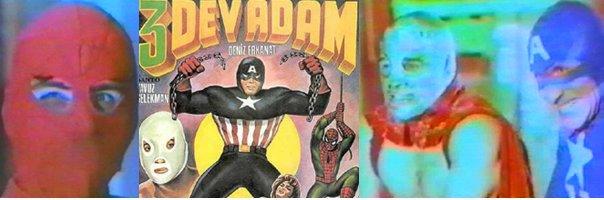
SPIDEY HAS A FUCKING SWITCHBLADE!

Goons: Boss! How are we gonna stop those mafia guys from snooping around on our turf?
Spider-Man: Gimme a minute here... WAIT! I'VE GOT IT!
Goons: Great! What's the plan?
Spider-Man: Build a tee-pee around me!
Goons: Huh!?
Spider-Man: You heard me! I want you to build a tee-pee around me using these wooden boards. The mafia guys will never notice it and then I'll be able to sneak attack them!
Goons: Uh sure, whatever you say boss.
Spider-Man: Muahahahahaha! My plan is brilliant!
Ok, so after
bloggin about the Indian Superman movie I came upon what is a treasure trove of superhero movies from all over the world. One of those that I mentioned in that last blogpost was
3 Dev Adam. So I
came upon what is probably one of the funniest reviews of any of these, um, "tribute" movies to date (from which the above quote is taken). And really, how can a review of one of these movies
not be funny?
What really makes this particular review shine is not that it has stills from the film--many of the reviews do--but that the images are animated gifs which just adds to the humor of the review! For example, the title of my blogpost is directly from the review, and was posted just under this

image.
Ok. So it might not be a switchblade. But anyway,
3 Dev Adam is a Turkish film that the IMDB site misleadingly summarizes with: "Istanbul is being terrorized by a crime wave, and the police call in American superhero
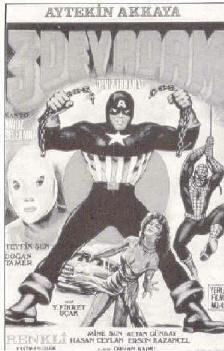
Captain America and Mexican wrestler Santo to put a stop to it" (I guess in Turkey the idea that Spider-Man is a public menace is taken literally?).
The bad guy, who is ostensibly Spider-Man (see the movie poster image to the right) doesn't really look like Spider-Man, but that's ok. According to -RoG-, Captain America isn't exactly the shining patriotic exemplar of an American superhero either:
There's a lot of things for America to be ashamed of, but this next scene has to be somewhere at the top of the list. I don't know why, but Captain America decides to hang from the ceiling in what has got to be one of the most bullshit non-scripted action sequences of all time. He hangs upside-down punching and kicking his enemies away with about as much force as a quivering newborn kitten. At one point he's hanging upside-down as if he thinks he's fuckin' Batman. This is the hero that's supposed to represent America? If that's the case, I'm frankly amazed our country hasn't been conquered by Iceland.
You have to see the animated gifs while reading the review to get the full effect.
After complaints about
Santo shoving things down his crotch, -RoG- gives us a little political commentary:
This is one of the only times we actually see him do something sorta like the real Spider-Man would do. He scales the wall of a house. Ok, he doesn't actually climb it with his bare hands sticking to it or anything, he climbs up a drainage pipe. But hey, in a movie this absurdly weak, beggars can't be choosers.
He soon makes his way into the woman's house and finds her in the shower and strangles her to death. There's two things I never thought I'd see happen in my life:
1) A monkey in charge of things at the oval office.
2) Spider-Man strangle a nude woman to death.
Well, now that I've seen both, I guess nothing from this point on will come as a shock.
Not that I'm knocking his review, but this just seemed like too cheap a shot. Given quality of the movie maybe it was warranted. I don't know, or really care. The little blurb about the killer guinea pigs was interesting though and I can't see why there should be blow up dolls in the underground den of the bad guys either.

Apparently the Spidey in this movie has the powers of Jamie Maddrox or something like that as it appears that
Santo and Captain America have to fight several Spideys. But after the first, -RoG-'s commentary:
Hell, Santo comes walking into the room with a dead Spidey hoisted up on his shoulders. I guess Santo ran out of room in his crotch, otherwise he surely would've shoved that dead Spider-Man in it, rather than carry him on his shoulders.
just made me loller.
It's kinda hard to tell if this is a serious movie, or if it happened to somehow follow on the heels of the Batman 60s camp (did the series ever get aired in Turkey?), but actually I guess what I'm wondering most is why the choice of Marvel Characters rather DC. I would have thought the DC characters were more iconic and international (especially given all the Superman/Wonder Woman/Captain Marvel/Plastic Man movie knock offs world wide).
Anyway, just read the
review, enjoy the gifs, and have a good time. If you want to get a copy of this or any of the other movies I've blogged about, check out the links in
this post.
__________
filed under: Asia; Asia Minor; Middle East; Turkey; movies
Being a Lazy blogger
Damn--so I wasn't thinking that post comments didn't allow the "blockquote" html tag. So rather than going back and changing all those to "em"s i decided to be lazy and post my response
to James here.
~~~~~~~~~~~~~~~~~~~~~~~~~~~~~~~~~~~~~~~
Posted before I have the sense to stop myself:
You'll have to forgive me here-- I was never all that smart, and I currently have half a bottle of crap shiraz in me, so I don't even know if this will all be in English.
Post all you want James. Even if it's just a Fluxus concrete poem I won't mind. I used to have some of the most interesting discussions with a physicist friend of mine at bars--being boozed up doesn't necessarily mean that you'll be at all incoherent.
I'm a little unclear here, because it seems like you're agreeing with my idea of 'never trust the artist.' But maybe saying there's a different reason for not trusting him? Or at least not relying on him?
In a sense, yeah I am--but at the same time, I'm saying 'never trust the critic' (re:
the intentional fallacy) because relying on a [particular] critical tradition's notion of what degree of
intentionality to accept in author's statements isn't any less problematic. And obviously these issues overlap with the whole idea of
close-reading which tends to be inextricably bound up with the
intentional fallacy. They create the the core of the so-called box of "Western Critical Theory" (or what I think the phrase
textually driven criticism best captures) as I'm perspectivizing it.
And I guess I should throw out what I'm [implicitly] contrasting with
textually driven criticism here so that some things might be a bit more clear (while at the same time other things will be more opaque). Forgive me for a moment as I make some broad sweeping generalizations as there will always be exceptions (see my qualifications for this
here).
I'm basically interested in cross-cultural criticism (if you haven't noticed) so in a nutshell we can talk about three
meta-traditions centering (historically) on ancient Greece, ancient India, and ancient China. Not that other cultures don't have a long critical tradition--that's obviously not the case, but these three in particular have the longest relatively
unbroken lines of a critical tradition. Now for some more problematic generalizations: the Greek tradition can be seen to have developed into a
textually driven one; the Indian tradition can be seen to have developed into a
aurally/bodily driven one; and the Chinese tradition can be seen to have developed into a
gesturally/visually driven one.
One big source of evidence (there are others) for these distinctions other than the criticism itself (which already perspectivize these ideas) is to look at the respective dramatic/theatrical traditions. Sure, there is overlap between the three--but if we use Neil Cohn's excellent distinction between
modalities of expression (e.g. distinction between verbal expression, gestural expression, and visual expression) in conjunction with a generalization of Carstairs-McCarthy's formulation of
synonymy avoidance principles (e.g. expression tends to diverge in some way to prevent overproductive synonyms) we can see a different emphasis between the three traditions. For example, if text is the focus of a traditional form, then the gestural and the visual aspects of the form will become
de-emphasized.
If we talk about the frames within which these respective dramatic traditions exist and the discourse referencing them we can sort of tease out these distinctions merely through statements made about them or describing them or in the theory and praxis of them. We're already going to have a problem with
ethnocentricity because the terms/phrases/statments that at least I will be discussing are generally going to be in English.
Generally speaking, traditional Western plays are
written. This is part of the Greek tradition. We have playwriters, screenwriters, scripts. Actors
read lines [of text], learn their lines, forget their lines. How long a particular piece lasts depends on the length of the script and how long it takes to perform the lines of the script. Laypeople can
read the scripts in published form. Programs for Operas usually include the
libretto (but not the music) in translation.
In traditional Indian theatre (usually referred to as
dance-dramas) movement and dance are almost always integral to the performance. These are usually not written, though some exceptions exist from the 5th century (e.g. Kalidasa). The "actors" (already a problematic term in some senses) learn the movement based "vocabulary" (another problematic term) of an intricately complex gestural "language" (need I say problematic?) that include
mudras/
hastas (depending on the time period the number of these "hand gestures" is usually around 70--the English alphabet only needs 26 letters to create litterally millions of words) and
chari ("leg movements") and
karanas (movements of both legs--the
Natyasastra lists 108
karanas). Text in Indian dance-dramas are rarely used alone (in between "acts" in some cases) and is almost never spoken (usually sung). Usually the actor dances the text (or we could say actors "interpret" the text through movement) whenever it is actually used. There also exists a number of genres of Indian theatre that are purely performed thorugh dance-narratives. Early Indian theories of language invariably dealt with the spoken form (in fact, early Western linguistics--which focused on phonology--was based on the study of Indian phonetic theory before it became more
textually driven). There are incredibly complex rules for precise pronunciation and memorization aids for the oral transmission of texts. Some modern day comparisons of written versions of these oral texts from different regions show that the rules of transmission made the texts much more similar than we'd think would happen through oral transmission. These precise rules for oral transmission are also reflected in the transmission of movements and gestures in the dance-dramas.
In traditional Chinese Opera (need I say that the "Opera" designation is problematic?) we see what might perhaps be call an incredible multi-modal form. I already mentioned some things regarding the
wu lao sheng character type that Gordon Liu performs, and like traditional Indian theatre there is a highly evolved gestural/movement vocabulary. Like I also mentioned there are precise rules for beard movements and even for
types of laughter (think Gordon Liu's performance again) and vocal enunciation.
A.C. Scott lists and describes dozens of
shou ("hand movements") and over a hundred
hsiu ("sleeve movements" which Zhang Yimou tends to capitalize on in his
wuxiu pian films,
Hero and
House of Flying Daggers). I could enumerate everything, but I focused on the hand and sleeve movements because some of this plays on the idea of Chinese writing--or rather Chinese drawing of
hanzi (characters). See, despite the fact that China had both the printing press and movable type centuries before Europe--calligraphy was still the preferred method of writing "texts." This has obviously influenced the history and theory of Literature and Literary Criticism in China--and has influenced how closely tied to Chinese brush painting calligraphy had become. Some important aspects of Chinese literary theory is tied to how to
interpret the actual brushstrokes of both brush painting and calligraphy. I think that in the movie
Hero, when
Nameless (Jet Li) talks about studying
Broken Sword's calligraphy as being the path to discovering the true extent of
Broken Sword's martial arts prowess--that's not just a metaphorical turn of phrase.
Obviously, these are gross over-generalizatinos, but I hope that I've at least focused a lens on some of the differences between cultures through the emphasis on different modalities of expression.
So going back authorial intention--it's not a matter of being able to trust him or not so much as it is a matter of how much skill you have in placing what he says in a context that might allow you to interpret whether what he says about his work is of any relevance to the work at hand. Obviously the work at had is the first place to find authorial intention--and what I mean by this subjunctive/counterfactual position: if the author had really intended something else, then the work would have existed as something else.
The author intends his work to be exactly as it is--and since I've made the distinction between the intentionality contained in the
intentional object as opposed to
an interpretation of an author's intention of the work by the author himself (which obviously then has it's own intentional content which may or may not be resonant with that of the object of interpretation at hand) I'm free to make a different set of critical distinctions that will allow me to take authorial intention more seriously than some forms of Western based criticism (e.g. those that accept the
intentional fallacy, for example) will allow. See it doesn't become a matter of trusting the author so much as being able to trust our own judgements base on our level of skill in interpreting. Again I turn back to the idea of
skillful means.
Obviously, because of the history of the printed text in the West, we lose alot of the subleties of the written hand that, say, Chinese Literary Theory would allow us to examine for the recovery of authorial intention--but that doesn't mean that Chinese Literary Theory hasn't found some generalizations from the recovery of authorial intention through "drawn" text that can be applied to texts of any sort. In other words, having had a healthy tradition of examining a mode of text ("drawn/written") may give us some insight on how to look for something else in a different mode ("printed") text. The same thing could be said of Indian theories of spoken language. The old adage "if a hammer is your only tool, then everything will start to look like a nail" is a ppropriate here, I think. I'd rather have either several different hammers, or maybe a saw or two; a scewdriver maybe; or possibly an awl--i.e. I like to jump boxes--with which to examine texts. I'd rather have a dense and rich interpretation than a plane that has been flattened of its nails.
Speaking of printing history, some of this
textually driven criticism has also been critiqued by
Johanna Drucker's in her works (especially in her analysis of experimental typology in the historical avant garde,
The Visible Word: Experimental Typography and Modern Art). Her work focuses on the techniques and theories surrounding the anlysis of written/printed text as a visual phenomenon--a focus on the iconic aspect of written/printed language that Jacobson and Pierce and Russian Formalists describe--rather than as just a notation system for abstract linguistic ideas.
Marc Singer also
invoked Jacobson to talk about the metonymic aspects of superhero comics which might be something easier done in media with a visual modality(?). Some linguists actually theorize that metonymy might be more fundamental than metaphor in language extension--but as Marc notes, metonymy isn't usually the focus of (at least) comics criticism.
See, all these things have a materiality and history (maybe I'm waxing a little Marx-ian on you now). We can talk about the death of the author all we want, but if we're reading outside the box of
textually driven criticism there are all kinds of things we can use to interpret the context of a work--which can give us the context of when the author produced the work--therby giving us some idea about the author's intentions (maybe not much, but some).
What I'm saying is that it seems like the paragraph I quote here comes to the same destination via different route that the "death of the author" guys travel. Please clarify for me.
Maybe it does--or maybe the box you're in only allows you to see it that way? I don't know if anything I've posted above helps, but it at least it gives you some context.
I'm surprised, actually, that all the things you do, Jon, are not the work of a post-modernist.
See, this sort of goes back to my idea of "skill" again. I would just say something like "I am." You call me a musician and I'll say, "Nah, I just happen to play alot of music." You can call me an illustrator and I'll say "Nah, I just happen to draw some illustrations." In other words, I'll just reference the things I can do (or maybe the skills that I have) rather than the adjectival qualities about the subject
me in a text. And in the end, I would just rather
do them than describe them. one of the other reasons I took so long to reply your blog post is because after thinking about the idea of "living post-modernity" I realized that I needed to have some sort of
online bio/resume (just because I get tired of constantly telling people what I do).
I had jumped on the "pomo bandwagon" back in '96 as I decided I didn't want to be just "a classically trained musician." I got over it (pomo that is) after a couple of years. My prediction is that pomo will be a footnote in history of modernity. I'll continue to do everything I've been doing (plus more to boot) but I really don't feel any different than I did before going off the deep end. If it's more difficult for people to categorize me, well tough--that hardly means I can't be categorized, only that people lack the necessary skills to do so. ;)
that I've meant to go into for a while. I believe critics are actually people who love an artform too much to be able to confine themselves to actually making it. I find the "those who can, do" formulation too easy.
Don't worry--I have a theory about practically everything too. See, this is where my distinctions allow me to interpret things differently. I would say that critics are actually people who love a particular response to certain artforms so much rather than the loving the artform itself. This is probably my inner Buddhist coming out again--the idea of attachment to certain feelings and emotions being what people really care about.
See, given this Buddhist viewpoint, I could say that a critic prefers the box that allows her to have a particular set of responses to one thing, say,
watching films, than to another thing, say,
making films. This distinction isn't as easy to make when everything gets flattened out to be
text to be interpreted. Given this distinction, I would say regarding:
I think film critics are actually people who love movies so goddamn much that they would rather spend their time consuming as many movies as possible, rather than just making a few. For a man who just absolutely loves movies, what's better? Making 2 a year? Or watching a hundred? I think you can only be a real critic if you love a given form so much you are possessed of the (completely insatiable, slightly irrational) desire to consume all of it.
that film critics are actually people who love
watching movies so goddamn much that they would rather spend their time consuming as many movies as possible, rather than making any. In other words, I'm perspectivizing the activity of
watching movies and the set of responses to that activity as opposed to the activity of
making movies and the set of responses to that activity. And we can contrast these activities with
writing criticism about movies and the set of responses to this activity.
There's nothing that essentially ties any of them together, but to go back to the
modalities of expression we could say that those who
make movies may not be as likely to
write criticsm about movies as those who just
watch movies--just because those who make already have an outlet for expression. But I think that's a false dichotomy--I'm sure that many filmakers love to watch movies, they just happen to use the
mode of expression of filmaking to make a commentary on cinema rather than the
mode of expression of writing to make their commentary on cinema. Ultimately,
those who love making movies is not coextensive with
those who love movies any more than is the latter coextensive with
those who love writing criticism about movies. I think this goes back to my issues with flattening out text as being inherently ambiguous because there isn't a distinction being made about the relative levels of skill readers have. And I think we can agree that loving to make or loving to write criticism about movies isn't intrinsically tied to making good or writing good criticism about movies.
Which explains for me why critics get so mad when a piece of work sucks-- it's like the entire art form reared up and spat at them. Imagine the man or woman you've loved your whole life cheating on you with the wife-beating slope-browed troglodyte next door. Fucking hurts, don't it?
Going back to the Buddhist attachment to responses--why a critic gets mad when a piece of work sucks is because he's so stuck in a box which has a set of expected responses to certain types of movies--namely those types of movies that the box already designates as being "good." I don't think our feelings and emotions are any different than our interpretations in these respects. We can change the way we feel (jump boxes)--whether or not we do so consciously depends on our abilities and skills (and willingness).
And see--this gets us into a whole other set of ethnocentric problematics--the idea that we are able to change ourselves fundamentally is looked at differently in different cultures. Even Charles Murray in his book,
Human Accomplishments: The Pursuit of Excellence in the Arts and Sciences, 800 B.C. to 1950, states (concerning the invention of
Meditation) that, "this is one aspect in which Eurocentrism is a genuine problem." I'll quote him at some length from the section on
Meta-Inventions in Philosophy (of which both
Logic and
Ethics are included):
The Invention of Meditation. India, culminating circa -200
Shortly after Homo sapiens developed consciousness, he must also have become aware of one of the curious aspects of consciousness, its chaotic substrate. However lucid the conversation we may be holding, or however intensely we think we are concentrating on the task before us, a little self-examination quickly shows that, flowing along just below the surface of the coherent line of thought, is a string of flighty, unpredictable, apparently uncontrollable other thoughts, irrelevant to what we're supposed to be thinking about. Try to walk for a hundred yards, for example, while thinking about nothing but the act of walking. Untrained people [my emphasis] can seldom get beyond the first few steps without finding that their attention has already wandered.
In this simple observation about the nature of human consciousness lies a challenge that was taken up sometime in the course of Hinduism's long development: focus the mind so that the tumble of extraneous thoughts is slowed, then stilled altogether. The practice that developed, which we know as meditation, is of unknown antiquity. It was certainly already in use when the Upanishads were put into writing circa -6C.
...
In the West, despite the importance of forms of meditation in Catholicism and some Protestant Christian churches, the word meditation has become identified with some of the flamboyant sects that attracted publicity in the 1960s and 1970s. In some circles, meditation is seens as part of Asian mysticism, not a cognitive tool. This is one instance in which Eurocentrism is a genuine problem. [my emphasis] The nature of meditation is coordinate with ways of perceiving the world that are distinctively Asian. But to say that the cognitive tool called meditation is peculiarly useful to the Asians is like saying that logic--my next meta-invention--is useful only to Europeans. Meditation and logic found homes in different parts of the world, but meditation, like logic, is a flexible, powerful extension of human cognitive capacity.
Meditation is also a bodily thing.
Mihaly Csikszentmihalyi describes it as
Flow:
being completely involved in an activity for its own sake. The ego falls away. Time flies. Every action, movement, and thought follows inevitably from the previous one, like playing jazz. Your whole being is involved, and you're using your skills to the utmost.
Not surprisingly,
Flow and Dr. C were invoked during the last time
intention and
interpretation were
discussed in the comics blogosphere. I don't think we can overestimate how much the idea of meditation permeates Asian history through the diffusion of
Buddhism as well as through indigenous traditions (e.g.
Taoism in China). It has become inextricably tied to the traditional dramatic traditions of Asia and is coincident with what we might call a healthy "martial arts" tradition throughout Asia (I've already mentioned the link between Asian dramatic forms and the martial arts
here).
Performance theorist and editor of
The Drama Journal, Richard Schechner, has discussed what he calls
Rasaesthetics and how that ties into recent research about the
enteric nervous system. Ever wonder why we have all the metaphors for emotions and the stomach (e.g. "butterflies in the stomach," "you got guts boy"), well here is your answer. In Japan the seat of the soul is in the
hara ("abdomen") which is why
seppuku (or
harakiri "abdomen" + "cut") happens as it does. Need I say anything about the phrase "navel gazing?" Most forms of meditation focus the attention on the stomach (as well as the mind)--as this is the seat of being able to modify the emotions. The
enteric nervous system needs the autonomy it does as our brains may not be able to react as quickly to life-threatening stimuli as is needed--the flight/fight response empties out the bowels to make flight easier (less weight to allow you to move quickly) or fight easier (nothing slowing down your movments). But being relatively autonomous from the brain means that the methods of control over it are different. Hence meditation.
It is integral to most foms of traditional Asian martial arts and traditional Asian theatre. And as such becomes a part of scenery of Asian arts and criticism. Reading texts about brushwork in Chinese calligraphy or sections from the
Natyasastra, or the treatises of
Zeami, the poetry of
Basho and you'll find
Flow and meditation. And the act of immersion is just part of that type of activity.
So to to give you the short of it. No, I think it's the critic's inability to jump boxes that allows him to get mad when a movie doesn't give him the response he wants.
But then, I question if Tarantino knew. And so here I am putting all the weight on the author, regardless of the final text (or is Liu the author of his performance? or how about I just smash a hammer on my foot right now and complete the circle of pain and confusion I've started?).
I would say it's a collaborative effort. Maybe Tarantino knows--maybe he doesn't. But Gordon Liu certainly does, and has been an actor within a cinematic tradition where he has often performed many of those traditional roles. See making a movie isn't unlike playing in a Symphony orchestra--you have one director, but many players. you need them all to make the whole, no matter how much the director does, he only shapes the performances--he is not the author of them--just the author of the shape of the performance. So this comes down to an issue of "multiple authorship" and therefore "multiple intentions" which isn't quite the same thing as single authorial intention.
The real problem with Kill Bill isn't the movie, but the polarizing effect of Tarantino. And thus I shall leave it, lest I go off on another tangent.
Eh? You can go off on as many tangents as you want here.
Oh, wait, was that rhetorical? The differences are important, man. They're what make you choose paint over clay, or dance over comedy (can we make stand-up the "tenth art," please? I fucking love stand-up; blue collar jazz, motherfucker).
It was partially rhetorical. But at the same time, going back to the idea of being able to "unambiguously designate something as ambiguous" there are ways to articulate the differences if you have the skill to do so. This was more of an aside referencing how often lit crit and alot of Western scholarship equivocate language and thought. Maybe more about that later.
I think communication is a basic human drive, like sex and sleep and eating. And all the things we do, including cooking and fucking, are variations on the attempt to "speak" to other people. So there's going to be fuzzy lines between forms, yeah, because all the forms are essentially trying to do the same thing.
Here's that "later." See, yeah we can call all these things just "communication" but that hardly does justice to the differences between different "forms of communication." By equivocating different forms of communication, the landscape gets flattened in a very particular (and in many cases predictable) way. And I think this is part of what
textually driven criticism does--and obviously by just talking (or in this instance posting) about different critical traditions in English, we flatten those traditions in very particular (and predictable) ways. That's probably one of the reasons I jump boxes--it keeps the landscape full of valleys and mountains.
What I can't do, or don't want to do (and why not? am I just too hidebound to try it another way?), is speak of a given work as an independent object. I can't talk about The Book, I have to talk about the book as uniquely constrained interface between Reader and Author.
See, that is question begging--just as my position is question begging. Whether or not we accept that there is something outside of ourselves non-solipsistically just boils down to whihc box we primarily are in with regards to cetain ideologies nd world viewpoints. But with those assumptions come differences in interaction with the world. And those're the differences that interest me.
Watch this. I can get really annoying and say that your different approach, rather than being wrong, is simply you, a Reader, "interfacing" with the Author in a completely different way than I. Much the same way two readers interpret a single text differently.
You see what I did there? I went all po-mo on your ass, even though that shit gives me the hives. How fucked is that? It's such a useful tool, I must admit, to make argument pointless. It's like the Academy's variation on the schoolyard trick of repeating everything you say till you get frustrated and walk away (that's how it works on me, anyway).
Nothing wrong with that at all. And it really doesn't defeat my position. I could just say that either you or maybe neither of us have the necessary skill to access the
"Truth" of a text or the
"True" authorial intention. This just comes down to question begging of both our positions.
You want to know what my blog is all about? Of course you do, what else could you possibly have to do with your life? My blog is me trying to figure out how all this shit works, in public, so that people like you will laugh at me and tell me my zipper's open.
Heh. You could consider mine to be the blogging equivalent of me beating amplified sheet metal on a stage.
I will end with a thought that really only just popped into my head today: artists misunderstand critics far more often than the reverse.
Perhaps. I would have to say in response that
artist-critics understand both more than either understands the other. ;)