Manga vs. Manhua
I know that
ComicsOne is officially defunct now, but just to add a different side to the whole
manga/comics debate, here's an interesting excerpt from the article
Crouching Tiger, Hidden Demand:
Not only were Chinese comics available, but their sensibility, aesthetics, and pacing were so distinct from the manga style that Kuo and ComicsOne editor Sean Sanders became convinced that theirs was an untapped cultural niche. Whereas manga is typically black-and-white, heavily stylized, and covers everything from sports to superheroes to girly coming-of-age stories, Chinese comics are luridly painted, usually restricted to medieval and ancient settings, and obsessed with kung fu. "They're very episodic and epic," Sanders says. "They're primarily martial-arts themes, and many of them take place in ancient China. They have a lot of emphasis on traditional Chinese medicine, Buddhism, Taoism, definitely a lot of traditional Chinese myths. ... We've found that our audience isn't your typical manga readers at all. For the most part, it's ex-comics fans who lost their taste for the contrived, brightly-colored super hero thing, and are looking for something deeper."
DrMaster has
officially taken over publication and and selling of backstocked
ComicsONe manga,
manhwa, and
manhua titles. You can download some free issues
here and purchase some individual issues and collections for a fairly cheap price at
Cubic Mall:
We are the official merchandise store for DrMaster Publications Inc. You can also find all books published by ComicsOne Publications here as we do carry their books. Lot of books are at special discount prices due to overstock or inventory clearance. This is the place where you can find the latest book releases of DrMaster Publications, ComicsOne and other publications.
Related Link:
Manga vs. Manhwa:
Manhwa invasion! (with a nod towards Manhua)
Chinese Mythology Presented in Comic Books and Comic Semiotics
Chinese Mythology Presented in Comic Books
What do Pan Gu, who separates the sky from the earth, Nu Wa, who patches up the sky and Kua Fu, who chases the Sun, have in common?
All are forgotten heroes from ancient Chinese mythology. Or so it would seem. Their stories have been told for generations in the past thousands of years.
But today their influence is weakening as Chinese children turn instead to the likes of Harry Potter and The Lord of the Rings for their fantasy fix.
Comics study in semiotics
Comic Semiotics is the first official research done on comics from the semiotics viewpoint in Korea. There have been many studies since the publishing of Communication in France, yet it is the first academic approach taken on the discipline of comics in Korea.
The Image of America
Call for entriesWittyWorld is conducting a worldwide survey on the "The Image of America" WittyWorld is conducting a survey of international perceptions of the United States, its influence, culture, and people. Cartoonists and artists are invited to offer their own version of opinions. A balance of views (positive and negative) is preferable, although the study is not necessarily looking to achieve that. The main goal is to mirror true images of how the world sees the U.S. as a whole
WittyWorld HomepageThe International Comic Arts Festival (ICAF)The International Comic Arts Festival, an annual academic conference, is dedicated to promoting the scholarly study and appreciation of comic art (including comic strips, comic books, albums and graphic novels, magazine and newspaper cartooning, caricature, and comics in interactive media).
ICAF Homepage
Dies Irae 2 page spread
Another selection from my
mini (click image for detail)
 Related links
:
because sometimes a picture is worth a thousand words...You Are Mini-Comics Creator
mein Gott!!
Looks like I'll be celebrating 10 years worth of internet presence in about a year and a half:
All too often we forget to do things. It is as if we don't realize that we are always doing. A Cagean "Aesthetics" can be a wonderful pedagogical tool for musicians, artists, hell, even scientists, and lawyers. Perhaps many of us, as La Monte Young said, need to ask, "Who is John Cage?".
Jonathan Silpayamanant
Greencastle, In USA - Monday, March 24, 1997 at 11:13:10 (EST)
from:
http://www.ibiblio.org/mal/MO/cage/1997.html
I still remember posting that (though not originally at this page)--I think it was the guestbook at the old
New Albion website.
1997 was also the year the I created what was originally the online
persona,
Noiseman433 (boy I better tell Bob/Xome to update that page soon), which is a very different type of being today than then.
I still remember the Listserves/Usenet days. I think I'm feeling my age now...ugh...
response to James pt. 2
Since I'm having problems with my posts going through at
James' blog, I thought I'd post my latest comment here. This is a continuation of a discussion James and I are having about interpretation. I posted my first rather lengthy response
here to which james responded
here. The following is my latest.
Weird. I don’t know why your comment went into moderation.
No biggie.
I don’t really believe that’s possible. I think every form of communication we have carries with it a certain diffusive quality.
You don't believe that's possible, and yet you think "every form of communication we have carries with it a certain diffusive quality?"
I think you're trying to have your cake and eat it too. These types of statements are precisely what I was referring to when I posted 'I don’t think it’s at all a contradiction to say something is “unambigously ambiguous” for example'. If you don't believe that's possible, then how is it that you can believe in the essential "diffusive quality" of every form of communication? In other words, how is it that you can interpret, unambiguously, that every form of communication has a "certain diffusive quality?"
Or how do you reconcile this purported diffusive quality with degrees of diffusiveness? For example, how is it that you would reconcile, if I were to interpret your statement:
"We have to use words with agreed-upon definitions in order to have a sensible conversation."
as meaning:
"What you seem to be saying is that 'The buddha is three pounds of flax.'"
as being less relevant than if I were to interpet that statement as meaning:
"What you seem to be saying is that 'There needs to be a consensus, or a set of conventions we agree upon for an act of communication to succeed.'"
Sure, you hinted at one criteria (in fact, your statement is one such criteria)--but how is that supposed to mediate this relevancy? And how would the criteria work for an author interpreting his own work as she is creating it (this being close to my idea of what might possibly be the "perfect" communicative act where there really isn't an ambiguity in what's being said or expressed)?
See, I think that you're making a claim about the limits of communicative acts (i.e. "texts") and I'm making a claim about the limits of human knowledge and skill in interpretation. The two different claims say as much, if not more, about our individual backgrounds than they say about the things-in-and-of-itself (to borrow from the Kantian noumena) we are interpreting. It's likely you're approaching things from a Western lit crit perspective, whereas it's likely I'm approaching things from a buddhist epistemological perspective. Your box doesn't make it as likely to accept certain things that my box does, and vice versa.
For you, there's probably little to be said about the critic's actual skill in interpreting. This is a perfectly resonant strategy to have given a Western lit crit box where the author (e.g. critic) is necessarily placed sur rasure because il n'ya pas de hors-texte; or the author, she be dead; or even if she's alive, then what she meant didn't matter much.
No author, only text.
Close-reading for critical distance.
Those outside the Western lit crit box are left to, as cognitive scientist Mark Turner states, "be obliged to begin by persuading critics that readers and writers exist, that mental events occur, and that neither individuals nor minds are in general reducible to external discourse."
"The Death of the Author as a specific product of the Western critical mindset" (as Jog so eloquently stated it) also doesn't have to be an accepted premise in a non-Western lit crit box, which means that the recovery of authorial intention and the critical tools and theories of the "non-Western critical mindset" may just be able to do things with texts that isn't quite possible (or probable) from the Western lit crit box.
For example, Chinese literary theory and criticsm (where there's a relatively unbroken line of criticism spanning almost three millenea) can be looked at as the search for the reconstruction of authorial intent. This isn't a box that can necessarily be approached from a Western lit crit perspective where all acts of communication have a diffusive quality because that's already dismissive of the whole theoretical foundation of another culture's rich literary critical history.
And no James--I don't think these are positions that you explicitly take. I've read enough of your comments/posts at other blogs (and your own blog) to know that you seem very intelligent and have insightful things to say. And I don't think that a so-called "non-Western lit crit" viewpoint or a comparative lingusitic viewpoint are any better or worse than a "Western lit crit" viewpoint.
I've already stated elsewhere that I'm much more interested in how statements we make implicitly show what Edward Said calls structures of attitude and reference (another box I like to dwell in you might say) and that there are certain ways we talk about texts that readers (in certain boxes) can interpret as being indicative of particular critical stances just because of the author/critics's attitude [relation] towards the texts they are interpreting and the types of things they reference while interpreting them.
I think we'll continue to disagree, which is fine. I thank you for giving me the opportunity to work through and clarify (more for myself) some of my own thoughts in relation to your own.
-J
Comic Covers of Evil

from:
"Four disturbing comic book covers from the 1970s"
http://www.delaurenti.net/strange.htm
Kenyan Comics
Sasa Sema PublicationsSasa Sema got its name in a Nairobi drinking joint called Zanzi-Bar. Sasa Sema means: "Hey, what’s happening?" in slang Swahili (but, literally, in Swahili, "Now Say!?").
The origins of the company stem from 1993, when Lila Luce, an American in Kenya, noticed that Kenyan children were reading Tin Tin and Asterix in English translation. Why weren’t these children reading Kenyan comics in Swahili, the language they are most used to? The answer: there weren’t any! This suggested the possibility of publishing comic books, with good stories, fun and serious, fiction and non-fiction, in full-colour, in Swahili, for the African reader.
The beginning was an up-hill task of sourcing cartoonists from leading newspapers in Kenya, explaining the idea to them and coming up with a publishable manuscript. Although most cartoonists were excited at the idea of getting published, many challenges were faced. Since 1996, when the first book (Gado’s Abunuwasi) came out, the company has published comics and cartoons in Swahili and English, children’s biographies of great African women and men, as well as stories and short literature in Swahili and English.
From inception, of the mission of Sasa Sema has been to stem African’s over-reliance on information from the developed world. The company’s objective is to reverse this trend by exporting highly-packaged information from Africa to the developed world. There are many genres of literature which have not ever been published in Kenya (and in most of Africa) and some of these are in the pipeline.
from:
http://www.canapublishinguk.com/home_of_sasa_sema.htm
Mr. Shi Eating Lions
Edit: 2005-09-20, 11:53 am
seems I've been misinformed by my friend. Please read section (3) Hanyu Pinyin is not a system for spelling Classical Chinese. It is a system for spelling modern vernacular Chinese from The Three “NOTs” of Hanyu Pinyin which has a short discussion about the Lion-Eating Poet in the Stone Den piece written by the linguist Yuen Ren Chao (pinyin: Zhào Yuánrèn).
Zhào Yuánrèn was the leader group that created the romanization system known as Gwoyeu Romatzyh ("National Romanization"; pinyin: Guóyǔ Luómǎzì). He wrote the poem Lion-Eating Poet in the Stone Den to demonstrate that Classical Chinese should not be romanized with Gwoyeu Romatzyh.
Thanks to Mark for the corrections.
A friend of mine who's teaching English and academic writing at
Shantou University in the Guangdong Province (about 150 miles north of Hong Kong) brought the story of "Mr. Shi Eating Lions" to my attention.
It was written just to demonstrate some of the absurditities implicit in the
pinyinization project as in some cases there may be up to 60 homophones for any particular "word" in Chinese.
The numbers after the pinyin words indicate tones. "1" is high tone; "2" is rising tone; "3" is falling-rising tone; "4" is falling tone; and "5" is neutral (sometimes marked with "0", "*", or preceded by a dot
before the syllable e.g. ·ma). Tone marks and diacritics are usually only used in textbooks as the current main use for pinyin is as a pedagogical tool to teach pronunciation.
Mr. Shi Eating Lions (in pinyin)
Shi2 shi4 shi1shi4 Shi1 shi4 shi4 shi1, shi4 shi2 shi2 shi1. Shi4 shi2shi2 shi4 shi4 shi4 shi1. Shi2 shi2, shi4 shi4 shi4, shi4 shi2 shi* shi1 shi4 shi4. Shi4 shi2, shi4 shi4 shi4 shi2 shi1, shi3 shi2 shi2 shi3 shi4, shi3 shi4 shi2 shi1 shi4shi4. Shi4 shi2 shi4 shi2 shi1 shi1 shi4 shi2 shi4. Shi2 shi4 shi1, shi3 shi4 shi4 shi3 shi2 shi4. Shi2 shi4 shi4. Shi4 shi3 shi4 shi2 shi4 shi2 shi1 shi1. Shi2 shi2, shi3 shi4 shi4 shi2 shi* shi1 shi1 shi2 shi2 shi* shi2 shi1 shi1. Shi4 shi2, shi4 shi3 shi4 shi4 shi4 shi2. Shi4 shi4 shi4 shi4.
(in English)
Mr. Shi, a poet who lived in a stone house, liked to eat lions. He vowed to eat ten lions. He often went to the market to look at lions. At ten o’clock, he went to the market. Just then ten large lions came to the market. At that time, he saw these ten lions. Relying on the power of ten arrows with stone tips, he caused the ten lions to pass away. He picked up the bodies of the ten lions and went back to his stone house. The stone house was damp, so he told his servant to try and wipe it (dry). After the house had been wiped (dry), he began to try to eat the bodies of the ten lions. As he was eating, he realized that the bodies of the ten large lions were actually bodies of ten large stone lions. Only then did he understand the real situation. Can (you) explain what happened? (Translated by Victor H. Mair)
Farewell to a friend
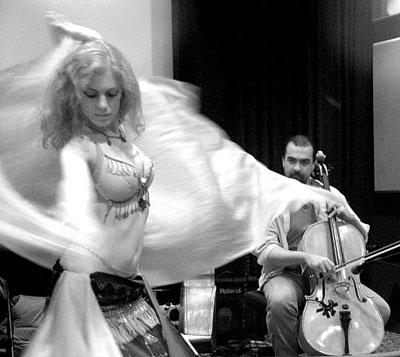
 Zweena bint Asya and Jon Silpayamanant, 9-18 (photo by Mark Lahey)
Now that I have some time to breath I thought I'd say some things about my wonderful friend and colleague, Sara Jo (
Zweena bint Asya), who will be moving back to Oregon in a couple of weeks.
Fort Wayne will be losing a wonderful talent. As a member of
il Troubadore I first met Sara Jo last December. She somehow heard that
il Troubadore performed Middle-Eastern influenced music and she contacted Robert to see if she and her
troupe could dance with us.
Sara Jo, who has studied with master dancers throughout the US and Morocco, has founded two belly-dance troupes (
Troupe Scheherazade in Boston and
Troupe Taleeba in Fort Wayne, IN) and has done choreography for and has performed as principal dancer for the
Lyric Opera of Chicago. With degrees from Wellesley and Harvard, Sara Jo is an active educator and instructor in Middle Eastern culture and many styles of dance.
Last night she and
Troupe Taleeba again danced to
il Troubadore's original belly-dance music to a relatively small but enthusiastic crowd. Though this may be the last time we work with her in Fort Wayne
il Troubadore are planning to bring her back to Indianapolis in the future to perform with us.
Good luck and keep on shimmying, Sara Jo!
More photos from and info about the show may be found
here.
Gerry Alanguilan on Manga vs. Comics
GERRY ALANGUILAN COMIC ART F.A.Q.6. How can you say that when you draw so much like the Americans?
Do I? What is the "American" style of drawing comics? Look at any batch of American comic books and you will see that they are a melting pot of styles from all over the world. The styles are so varied, so wildly different that one cannot come up with a unifying set of characteristics that can comprise a single art "style".
And that is why manga is so unique. The Japanese were able to create a style that has a very specific style, allowing for a certain amount of individuality, but are so similar that they can be grouped into one unified movement of art.
Thanks to
Budjette for pointing out
Gerry's blog and the
Filipino Comic Book Portal blog.
"Stretching the concept of the Pinoy superhero"
Stretching the concept of the Pinoy superhero
By Wincy Ong
The Philippine STAR 03/11/2005
Lastikman should set the trend in Pinoy comic book superheroes and send out reminders to creators working in the industry today. Stop making stories about those blue-eyed, spit-curled, square-jawed, white supermen out to protect and serve generic First World megapolises. We’re all brown, dark-haired, snub-nosed avengers with Mexican last names. Put your chin up and let’s fly.