Disco Boys, eat your hearts out!
"Disco is not dead! Disco is LIFE!"--Tony P
I never properly thanked David Carter of
Yet Another Comics Blog for suggesting that
il Troubadore cover the Bee Gees' tune,
Stayin' Alive. So here is that BIG thanks!
It's become one of our biggest hits (second only to our cover of
Devil Went Down to Georgia). I think I've seen more Travolta "imitators" since we started performing this these past few months than I've ever seen in my whole life.
So please, if you have a chance, check out Dave's blog for
tons of reviews (I don't see how he has the time) as well as both Dave's and
TangognaT's blogs for updates about the ubercool
wiki comics projects.
And for those of you wondering what the Bee Gees sounds like played acoustically on mandolin and cello, have fun with this early draft (we've since revised it extensively):
Stayin' Alive (mp3, 2602k)
I never thought playing disco acoustically would be so fun. Off to a couple of shows now, so more blogging later.
*update* ok, so I guess the Wild Cherry tune might very well be our biggest hit."Stick with me, Tony, and you will dance again... when I rule this town."--Casonova Frankenstein
Old Master Q

If you want to ask which comic strip in Chinese history has never died out, has been on the comic sales ladder for a long time, and has became a part of the international Chinese society, undoubtedly it is Alfonso Wong's "Old Master Q".
from:
A Brief Background of Alfonso Wong (in English)
A Brief Background of Alfonso Wong (in Mandarin)
Every once in a while I'll post about Alfonso Wong's
Old Master Q. No real reason other than to maybe draw in comics fans that are looking for something other than US comics or
manga.
First published as a strip in 1962,
Old Master Q has been on the big and small screen, as well as on the stage:
What would Old Master Q look like on the big screen? Since the 1960's, "Old Master Q" has been made into 4 Cantonese and 2 Mandarin cartoon animations, TV series and plays. In 2000 Tsui Hark's Film Workship used "Old Master Q" as the movie's theme, producing a live-action movie with 3D cartoon characters. The laughter was endless because of the cameo appearance of the comic's 76 year old creator Alfonso Wong.
from:
Old Master Q is Timeless (in English)
Old Master Q Is Timeless (in Mandarin)
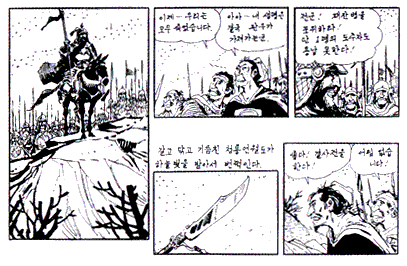
Old Master Q has enjoyed popularity throughout Asia and as you can see from this example below and from the dailies at the
website, like a number of far eastern and south-east asian comics there's far less emphasis on
text-driven storytelling.

The difference between what I'm calling
text-driven narratives and
image/dance-driven narratives will be one of the major focuses here at
Mae Mai since the climate seems to be rife for it given the so-called "
manga invasion" and all the discussions regarding it on the net.
Related Links:Emaki Productions"
The Grammar of Manga" Matt Thorn, April 2005
Image [&] Narrative Online Magazine of the Visual Narrative
"
Manga story-telling/showing" Aarnoud Rommens, August 2000
Matt Thorn's website
Comic Book Operas
While doing a Google search for news of Art Spegielman and Philip Johnston's Comic Book Opera,
Drawn to Death: A Three Panel Opera, I came across this:
4. Comic Book Opera - This MAP performance task requires students to view an opera and create a comic book representing the opera along with a letter explaining the process and reasoning used in creating their book.
link:
LESSON PLANET
What a wonderful project. Granted,
P. Craig Russell's (I really need to read his
Salome) been doing this for, well, decades. But this seems like the sort of curriculum addition that
Neil Cohn would approve.
Other Music/Comics Related Links
because sometimes a picture is worth a thousand words...
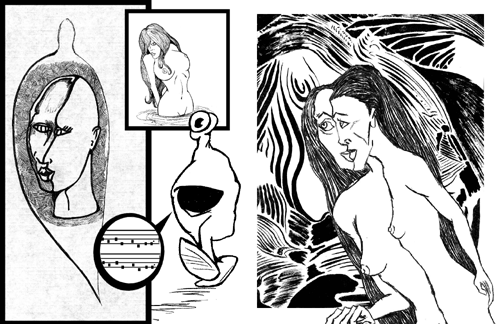
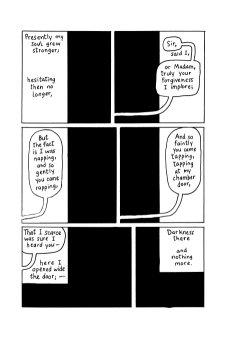
A page from a new mini of mine,
Portrait of a Temporal Progression as a New White Wall, inspired by
Emmett Williams' novel,
E, and the discussion in
this post.

But if that left you feeling a little bit
empty inside, then enjoy a couple of pages from my mini,
Dies Irae:

*click on thumbnails for larger images.
International comics creators' deaths
Not Eisner or Kirby, but...
 Korea
KoreaGo U-yeong (1939-2005)
link via Shawn FumoThe cartoonist Go U-yeong, who died Monday, spent much of his 50-year career fighting censorship. He poignantly recalled seeing his creations torn apart and blanked out with white ink.
Cartoonists finally get some respect
 Israel
Dudu Geva (1950-2005)
“The Song of the Duck” — itself an absurd play on “swan song” — probably is the most impressive high-wire act in comics history. Nothing else ever was this sustained. Not Charlie Brown and his kite, not the thumpings Beetle Bailey takes from Sarge, not Dagwood’s sandwiches. Every other cartoonist settled into an array of gags, but Geva’s duck was resoundingly one-note.
Recalling an Israeli cartoonist who refused to duck the truth
 Turkey
Oguz Aral (1936-2004)
founded the weekly comic magazine "Girgir" in 1972 and made it the third largest selling such magazine in Europe with a circulation of 300,000. The magazine became a center where young and aspiring cartoonists would be educated and learn the tricks of the trade. Generations of cartoonists learned what to do from Aral. Aral's aim was to make caricatures simple and accessible to people.
Tr: Godfather of Turkish caricature bids farewell
You Are Mini-Comics Creator
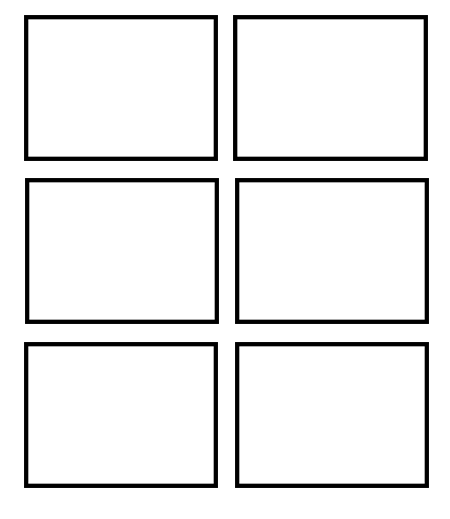
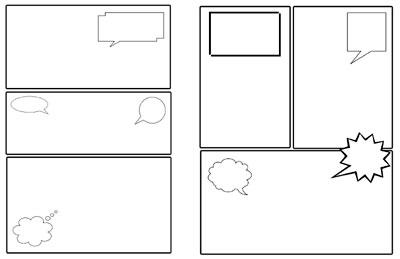
Here are a couple of pages from my mini-comic,
You Are Mini-Comics Creator (2005).

Since
Neil Cohn called me out on the claim that
imageless comics are just what we call a "book," I thought I'd offer my own counter-example to the apparent lack of imageless comics.

Neil
mentioned the experimental poet, Kenneth Koch, and posted a
link to a vid clip of one of his lectures with Charles Hatfield at the 2004 ComiCon about one of Koch's books,
The Art of the Possible! Comics Mainly Without Pictures (Soft Skull Press, 2003).

Neil also linked a
post from
MadInkBeard, where Derik Badman disusses the work of
David Lasky, in particular Lasky's comics adaption of Poe's "The Raven" in the
Orchid anthology (Sparkplug Comic Books, 2002).
So we have what are ostensibly the works of three creators (if I do not so humbly include my own) that
prima facie demonstrate the existence of imageless comics. But really, as the tired adage goes, "the exception prove the rule." I explicitely created my mini (as well as its companion piece, "in memoriam John Cage") to prove my claim about the absence of imageless comics, false. But does this give us good reason, ala McCloud, to not talk about what is
essential to comics: namely the sequence of images. While both Neil and perhaps Derik may disagree with McCloud and me, I question the fact that any of these examples are
really imageless (for the record, Derik doesn't claim the Lasky work is without images, only that they play a very small role in it).
Not really wanting to get into this too deeply (since the whole idea of pointing out the paucity of imageless comics was tangential to the main issue I was making in a
previous post) I'd rather pose some questions. And let's leave aside the whole problematic of
text being very specific types of images.
The questions are:
1) Are any of the examples above really imageless?
2) If we omit the text from the latter two examples, would the pages be imageless?
3) Is my example actually imageless?
4) What are all those lines and blocked shapes then? Sure, we may call them the "frame," or just simply call them "panels" and "word/thought balloons," in other words, just the bearers or containers of the images (which, if I'm not mistaken, is Neil's hypothesis).
5) Was Scott McCloud just talking bunk when he stated that two black squares, side-by-side, constitutes comics or a "map of time?"
I'll just give some preliminary and quick remarks--though I don't consider this discussion closed by any means. Books are generally used to bear or frame what we might call "linguistic images" (or maybe "lexical images"). These are obviously different than what we might call "pictorial images" or, if we need,
sequential art. I don't think most of us have a problem with distinguishing between the two, but for now I'm going to leave it at this.
If you want an excellent overview of the traditional debate between "text" and "image," you could do a lot worse than reading W.J.T. Mitchell's
Iconology: Image, Text, Ideology or reading a number of the essays found at the online magazine of visual narrative,
Image and Narrative.
Tom Yum Goong
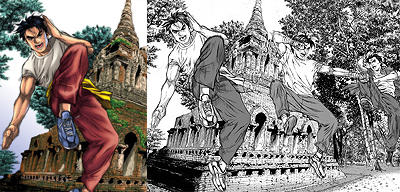
Coinciding with the recent release of
Tom Yum Goong (that's Thai for "shrimp soup") is the comic of the same name.

So we might finally see a Thai comic book break into the international market. With all the licensing surrounding the international release of Prachya Pinkaew and Tony Jaa's latest movie I'm wondering if the comic will even live up to the hype as most film-to-comics adaptations seem to fail miserably.

The comic will be published by (the Thai version is already out)
Vibulkij and is created by the team of Jirapong Sornakorn "Yoong" ("Mosquito") plus a couple of assistants. Fellow cartoonist, Mongkorn Sorapol, will be headlining the creation of the comic
Kon Bin Hern Fah ("The Flying Man") which is also based on Tony Jaa's character,
Kham, from Tom Yum Goong.
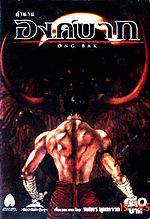
Apparently there was also an
Ong-Bak (image to the right) cartoon book published a while back as well (see link below for some scans).
Sources:
"Tom Yum Goong Sketches" DekNang.com August 12, 2005 (in Thai)
"Entertainment: See the movie, read the comic book" Sirivish Toomgum August 22, 2005
Tonyjaa.orgSketches and scans of the
Tom Yum Goong,
Kon Bin Hern Fah, and
Ong-Bak comics:
DekNang.com (in Thai)
Ong-Bak cartoon book gallery @ Tonyjaa.orgTom Yum Goong comic book gallery @ Tonyjaa.orgReleted Links:
Ong-Bak (movie IMDB page)
Petchtai Wongkamlao (actor IMDB page)
Prachya Pinkaew (director IMDB page)
Tom Yum Goong (movie IMDB page)
Tony Jaa (actor IMDB page)
Tonyjaa.org (The Unofficial Tony Jaa website)
Image as "Text"
*some minor editing due to stupid spelling and syntactical errors (2005-08-29, 10:39 pm)Dan began an
old post with:
Something Jon posted in my comments down below got me thinking about something. We were talking about the assumed primacy of text in reading (he was talking, I was injecting pointless nonsense here and there...), and alternative modes, or lenses through which a critical apprehension of an art object may be obtained (in addition to, not instead of, the text itself, just so I'm clear) came up.
He continued with:
A link to a published discussion between a neurologist and a mathematician sent me off on a mental tangent from which I was destined not to return, and I started thinking about the apprehension of the universe through use of mathematics.
I never really responded--or rather, my response was short (and I guess there's some sort of half-life for Haloscan comments as most of my old comments at Dan's blog are gone), and didn't necessarily get into the meat of what I was thinking about.
See, in the end--written and printed mathematics are just another kind of text. As are
music notation, various
dance notations (e.g.
Labanotation and
Benesh Movement Notation), as well as
SignWriting. All of these are
read, but obviously not all of them are read by everyone (or read in the same manner).
This is true of written languages--I doubt there is anyone that can read them all (or that they are all read in the same manner).
See, one of the functions of criticism--for me at least--is the ability to articulate differences. In other words, being able to tell why
A is different than
B while giving some sort of account of why that difference exists. For example, why is it that almost all
logographic scripts (e.g. Hieroglyphs; those by various cultures that use Chinese characters) are read vertically rather than horizontally as is the case with almost all
alphabetic or
phonetic scripts? What is it about the orthographic direction of certain classes of scripts that make them more likely to be read in the direction that they are read? What are the implications for the construction of meaning due to differences in scripts?
These are the types of questions that interest me and now maybe you can see the direction I'm going. Whether or not comics "writing" constitutes another type of "language" as
Neil Cohn contends (and that
Scott McCloud seems to imply) makes no difference because in the end, the form is still just another complex set of symbolic notations just as mathematical notation and labanotation are. At the same time, the type of notation that it
is makes reading it as different as reading music notation or reading SignWriting (or as reading a
logographic script).
This is not to say that there is an absolute difference. I don't at all mean to imply that at all--all of these forms of notations ultimately happen "in the head," so to speak, so there is ultimately going to be some overlap of function about how meaning is created, or how the script is read.
But going back to the "assumed primacy of text in reading" that Dan mentions--more often than not this leads some comics criticism into litcrit. Which is fine. I have no problem with using literary criticism to analyse comics--some interesting and fascinating interpretations may be constructed in that manner. But in the end, I do have to agree with McCloud that comics are
essentially a "visual" form of communication (obviously this is problematic as we can see that any "text" is visual in nature). In other words, while we may very well have wordless comics, or "sourds" as they are sometimes called in French
bande dessinée criticism, we couldn't very well have
imageless comics (i.e. "picture-less"). The latter would just be called "books" after all.
So, with apologies to
Dave Fiore I'm going to have to disagree with the equivocation of narrative and language; to any bloggers out there, with the equivocation of language and thought. Sometimes we can think without words--and in many cases we can even
write and
read those ideas without words.
International Comics Resources
I've added a number of links to international comics resources to the right. I'll add links as I find them while cleaning out my favorites.
enjoy